


What makes some SaaS brands earn backlinks while others keep paying for placements?
How do a few SaaS companies turn their product, data and ecosystem into links from DR 50+ websites?
That is what this article breaks down from a SaaS SEO point of view. Gartner projects worldwide IT spending to reach $6.15 trillion in 2026, with software remaining one of the key growth categories.
SaaS companies have linkable assets most websites cannot copy: free tools, integration pages, customer data and expert commentary.
The advantage comes from using those assets with intent. You will see how link building for saas works through SaaS-specific strategies that help brands earn backlinks from relevant websites and build authority over time.
What Is Link Building for SaaS?
Link building for SaaS is the process of earning relevant backlinks from trusted websites to improve rankings, traffic and product sign-ups.
For SaaS brands, the goal is rarely backlink volume. The real goal is authority around pages that influence trials, demos and revenue. A SaaS link building agency can help teams point their outreach at those pages.
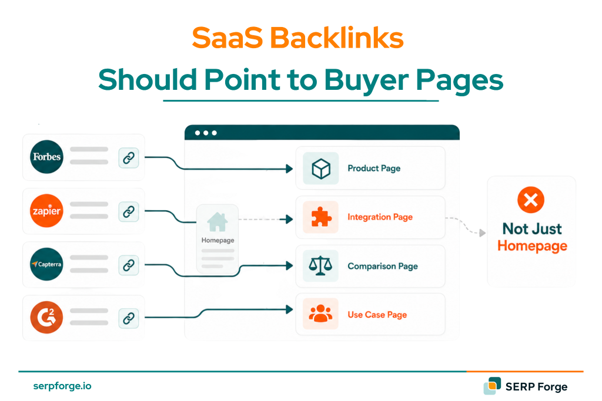
Our take is that homepage backlinks are overrated for SaaS.
If the product page cannot rank, the comparison page has no authority and the integration page has no links, a higher domain DR will only hide the real issue. SaaS link building should be judged by how much authority reaches buyer-decision pages.
That includes:
- Product pages
- Integration pages
- Comparison pages
- Use-case pages
Ahrefs found that 96.55% of pages get no organic traffic from Google. That is why SaaS content often stalls after publishing. A page may be useful, indexed and well written, yet still struggle without authority signals.
SaaS link building performs better when the link supports buyer intent. A free tool can earn citations. A data study can attract journalists. An integration page can earn partner links. A customer story can earn links from niche publications.
The page receiving the backlink matters as much as the website giving it.
A backlink to the homepage may help brand discovery. A backlink to a comparison page can help a buyer choose. That is the real difference in SaaS SEO.
How Is SaaS Link Building Different From Traditional Link Building?
Traditional link building often focuses on general authority. Competitive SaaS SERPs require a link plan because buyers compare products across vendor pages, review sites, alternative pages, and educational content before they convert.
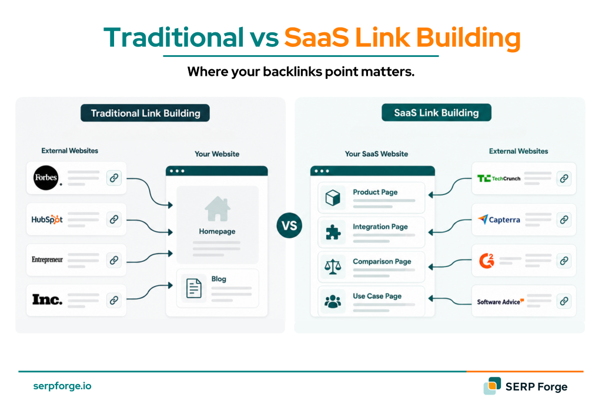
SaaS links should support product discovery, build trust, and help qualified buyers find the product during research.
Here is how the two approaches differ:
| Area | Traditional Link Building | SaaS Link Building |
| Main goal | Improve domain authority | Improve rankings for product-led pages |
| Link targets | Homepage and blog posts | Product, comparison and use-case pages |
| Best sources | General blogs and directories | Tech sites, partner pages and review platforms |
| Content asset | Guest posts and guides | Tools, data reports and integration pages |
| Success metric | Referring domains | Trials, demos and assisted revenue |
SaaS buyers usually compare tools before they speak to sales. They read review pages, alternative pages, Reddit threads and expert roundups.
That changes where backlinks should point.
A link from a relevant software review article may bring fewer visitors than a broad business blog. Those visitors can still be closer to purchase.
SaaS link building also needs page-level planning. If every backlink points to the homepage, product pages remain weak. If links support commercial pages, those pages have a better chance of ranking for bottom-funnel keywords.
Which SaaS Link Building Strategies Earn Authority?
SaaS link building should connect each backlink source to a page that can influence trials, demos or product discovery.
The goal is to know which asset can earn the link, which page needs authority and which buyer journey the link supports.
Use these SaaS link building strategies to build a backlink profile around product value.
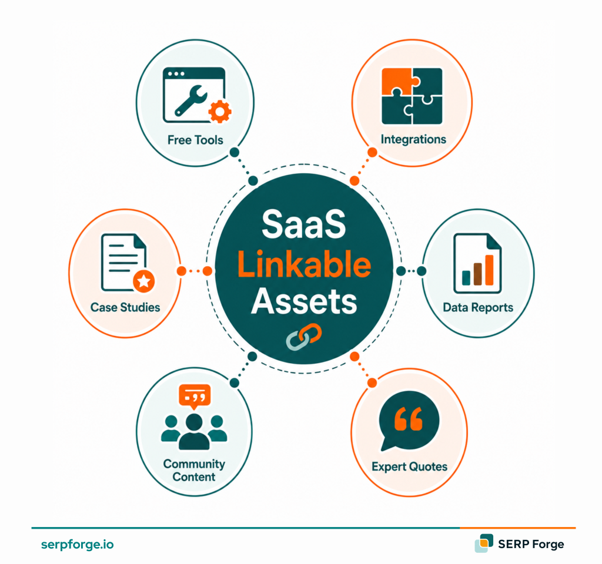
1. Free Micro-Tools and Calculators
Free micro-tools help SaaS brands earn backlinks from resource pages, tool roundups and comparison articles.
A calculator or scorecard gives editors something useful to reference. It also gives buyers a reason to interact with the brand before they book a demo.
Good assets for this tactic include:
- ROI calculators
- Cost estimators
- Benchmark checkers
- Readiness scorecards
This is useful when the SaaS product solves a problem people already calculate manually.
For example, a sales SaaS can build a pipeline leakage calculator. A finance SaaS can create a budget planning scorecard.
The outreach angle should lead with the user outcome.
Better pitch angle:
“Your readers can estimate lost pipeline value before choosing a sales tool.”
Weak pitch angle:
“We launched a new calculator and thought you may like it.”
2. Integration and Partner Pages
Integration pages are often underused backlink assets.
When two tools connect, both teams have a reason to publish setup guides, marketplace listings or help documentation. Those pages can link to each other in a natural product context.
Use this approach for SaaS brands with:
- API partners
- App marketplaces
- Workflow integrations
- Co-marketing partners
The best integration page answers one practical question:
“How does this integration help the user complete a workflow faster?”
A useful integration page should include the use case, setup steps, partner mention and next action.
After publishing, ask the partner for a link from:
- Marketplace listing
- Help centre article
- Partner directory
- Launch announcement
The request should show how the partner’s users complete the workflow faster.
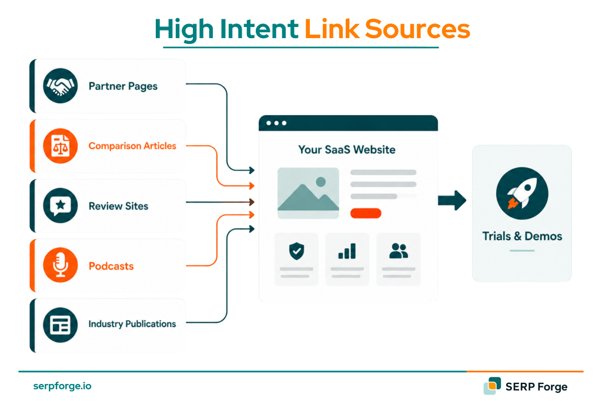
3. Original Data and Industry Surveys
Original data gives SaaS brands something other websites can cite.
A survey or benchmark report can earn links from journalists, newsletters, bloggers and industry analysts. The link comes because the page becomes the source of a specific claim.
Use this strategy when your team can produce a data point the market does not already have.
Potential angles:
- Buyer behaviour in a specific category
- Workflow gaps by company size
- AI adoption by team function
- Cost benchmarks across SaaS teams
The report page needs four things:
- Methodology
- Sample size
- Key findings
- Downloadable charts
Pitch one finding first. The full report should support that finding once the journalist or editor wants more detail.
A vague report rarely earns links. A specific stat with a useful headline gives writers something they can quote.
4. Digital PR
Digital PR is useful when the brand has a story journalists can cover.
The backlink comes from editorial coverage. That means the campaign needs a news angle before it needs a link target.
Good SaaS PR angles often come from:
- Market timing
- Buyer behaviour
- Original data
- Founder expertise
A cybersecurity SaaS can comment on breach trends. A HR SaaS can release data on hiring changes. A finance SaaS can share budget planning benchmarks before annual planning season.
The campaign page should feel like a source page.
Include:
- Key finding
- Short context
- Expert quote
- Media contact
Avoid turning the page into a product pitch. Journalists need a page they can cite without feeling like they are promoting your software.
5. Competitor Backlink Gaps
Competitor backlink gaps help you find link opportunities with proven intent.
The website has already linked to a similar SaaS product, guide or category page. That makes the outreach warmer than a cold prospect list.
Start by checking:
- Which domains link to competitor comparison pages
- Which sites mention competitor tools in listicles
- Which resource pages include similar products
- Which partners link to competing integrations
Then filter every prospect manually.
Check whether the site has real organic traffic, relevant content and sensible outbound links.
Do not copy a competitor’s backlink profile blindly. Some links may be old, paid, irrelevant or risky.
The best outreach angle is simple:
“Your article includes tools in this category. This page may help readers compare another relevant option.”
6. Case Studies
Case studies earn backlinks when they show proof that other writers can use.
A customer story with no data is useful for sales. A case study with a specific lesson can become a linkable asset.
Make the case study useful outside your own funnel.
Add:
- The original problem
- The workflow change
- The measurable result
- The takeaway for similar teams
For example, a customer support SaaS can publish a case study on reducing first-response time. That page can attract links from CX blogs, support operations guides and partner content.
The outreach should lead with the lesson.
Instead of pitching “our customer story,” pitch the insight:
“How a 12-person support team reduced first-response time after changing its ticket routing process.”
That gives editors a reason to link because the page teaches something.
7. AI Citation Building
AI citation building needs pages that answer buyer questions directly.
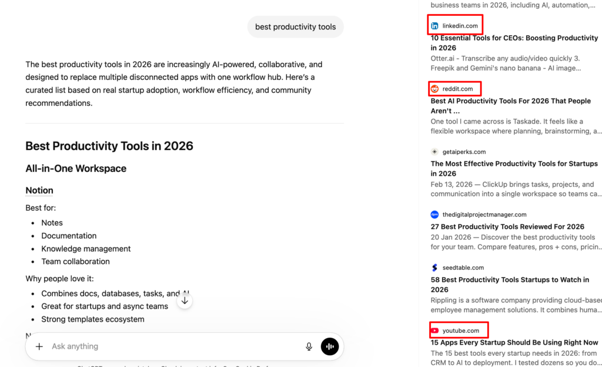
SaaS buyers now use AI Overviews, ChatGPT, Perplexity and Gemini to compare products, understand categories and shortlist tools. Your content needs to be easy for those systems to identify, summarise and cite. That is the focus of SERP Forge AI SEO services for SaaS brands.
Start with pages that match natural-language queries:
- What is [category] software?
- Best [category] tools
- [Product] alternatives
- [Category] software examples
Each page should answer the main query in the first few lines. Then add examples, sources, related entities and buyer questions.
For listicle visibility, focus on external pages too.
Track whether your brand appears in:
- Best tools articles
- Alternatives pages
- Comparison guides
- Category explainers
A backlink from these pages can support both referral traffic and AI discovery.
8. Reddit and Community-Led Links
Reddit and community links are useful when the answer earns attention before the link appears.
The mistake is treating communities like link drops. Moderators and users can spot that quickly.
Use communities to find questions buyers ask in their own words. Then answer with examples, numbers or process steps.
A good community response follows this order:
- Direct answer
- Practical example
- Optional resource
- Follow-up reply
The link should point to something useful, such as:
- Template
- Calculator
- Benchmark
- Practical guide
Even nofollow links can help if the thread ranks, gets bookmarked or influences a writer researching the topic.
Good communities to monitor include Reddit, Slack groups, Indie Hackers and product-led communities.
9. Journalist Source Requests
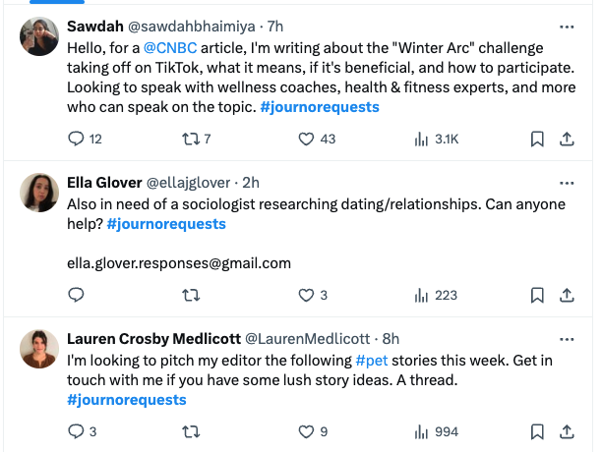
Journalist source requests help SaaS founders earn editorial mentions without running a full PR campaign.
Platforms such as Qwoted, Featured and Help a B2B Writer connect writers with expert sources. The opportunity is time-sensitive, so late replies usually get ignored.
A useful source response should include:
- Direct answer
- Specific example
- Expert credential
- Source page link
Build quote banks around repeat topics.
For SaaS, useful categories include:
- Buyer behaviour
- Market trends
- Product category shifts
- Common customer mistakes
The quote should sound like something a journalist can paste into an article. Avoid soft claims and product promotion.
A named founder or product leader usually has more citation value than a generic brand response.
10. Podcast Appearances
Podcast appearances help SaaS brands earn backlinks from episode pages, guest bios and show notes.
They also put the founder in front of a niche audience that may already understand the problem.
The pitch should centre on what the audience will learn.
Good podcast angles include:
- Founder lessons
- Category trends
- Customer mistakes
- Market shifts
Choose shows based on buyer relevance.
For example:
- Product analytics founders can target product and data podcasts.
- Cybersecurity founders can target security and compliance shows.
- HR SaaS founders can target people operations podcasts.
- Finance SaaS founders can target CFO and operations podcasts.
After the episode goes live, reuse it. Turn the discussion into a blog post, short clips, a newsletter section and sales enablement content.

Which SaaS Link Building Mistakes Kill Rankings?
SaaS backlinks lose value when the strategy chases volume instead of buyer relevance.
Here are the mistakes that hurt SaaS SEO most:
Building Links Only to the Homepage
Homepage links help brand discovery, but they rarely help a specific money page rank.
A SaaS company also needs links to product pages, comparison pages, integration pages and use-case pages. These pages usually sit closer to revenue.
Chasing DR Without Checking Traffic
Domain Rating is useful, but it can be manipulated.
Before approving a site, check organic traffic, topical fit, indexed pages and outbound link patterns. A DR 70 site with no relevant traffic can be weaker than a DR 45 niche site your buyers read.
Repeating Exact-Match Anchors
Exact-match anchors can look unnatural when repeated across guest posts and placements.
Use branded, partial-match and natural anchors. The anchor should fit the sentence and help the reader understand the page.
Treating SaaS Like a Normal Blog Site
Many SaaS teams build links to informational articles only.
That creates blog traffic, but it does little for demo pages or product-led keywords. The backlink plan should connect blog authority to commercial pages through internal links.
Ignoring Google’s Spam Policies
Google’s Search Status Dashboard lists a March 2026 spam update that began on 24 March 2026. That makes link safety a current SEO concern.
SaaS teams should avoid paid link schemes, scaled low-value placements and backlink sources built only to manipulate rankings.
Before approving any placement, check:
- Topical relevance
- Traffic quality
- Editorial context
- Outbound link patterns
Reporting Links Without Business Impact
A backlink report that only shows DR and link count is incomplete.
SaaS teams should measure how links influence impressions, rankings, referral visits and demo activity. That is how link building becomes a growth channel.
How Should You Measure SaaS Link Building Success?
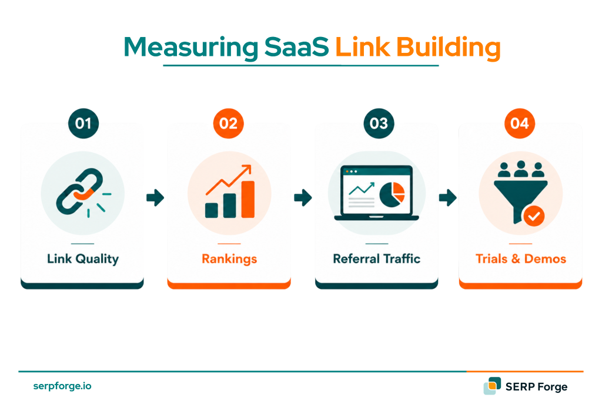
SaaS link building should be measured at four levels: backlink quality, search visibility, referral behaviour and revenue impact. Each level answers a different question.
For SaaS, add one extra layer: buyer-page authority. Group links by the page they support:
- Discovery: blogs and guides
- Evaluation: alternatives and comparisons
- Product: features, integrations and use cases
- Conversion: demo, trial and pricing pages
This shows whether backlinks are helping traffic only, or also supporting pages buyers check before speaking to sales.
Use these four checks to connect every backlink with visibility, engagement and revenue:
Backlink Quality
Start with the quality of each referring domain.
Track:
- Referring domains
- Domain Rating
- Topical relevance
- Link placement
A link inside the main article body usually carries more value than a footer or author bio link. A relevant SaaS publication is also more useful than a broad website with no product connection.
Search Visibility
Next, check whether target pages are gaining visibility.
Google Search Console’s Performance report tracks total clicks, total impressions, average CTR and average position. These metrics help you see whether a linked page is gaining search visibility before traffic rises.
Impressions often rise before clicks, especially when a page moves from page two to page one.
Track the target page and its keyword cluster. Sometimes a link helps related keywords before the primary keyword changes.
Referral Traffic
A good SaaS backlink can send buyers directly to your website.
Use GA4 to track referral sessions from each linking domain. Then review engagement, events, sign-ups and demo clicks from those visits.
Referral traffic is useful because it shows whether the placement has a real audience. A link that sends qualified visits has value beyond ranking signals.
Conversion Impact
The final layer is revenue influence.
Track assisted conversions from link-building traffic. Review how many visitors later return through organic search, branded search or direct traffic.
For SaaS, the best link-building reports connect backlinks to:
- Trial sign-ups
- Demo requests
- Pipeline influence
- Customer acquisition cost
This keeps the campaign focused on business value. Links are a means to better discovery, trust and conversion.
Want to know which SaaS backlinks would help your rankings?
SERP Forge can review your backlink profile, competitor gaps and money pages. You will get a SaaS link building plan built around product pages, buyer intent and DR 50+ backlink opportunities.
Book a SaaS link audit today.
Conclusion
Link building for SaaS works when backlinks support the pages that influence revenue.
Generic link building often stops at guest posts, homepage links and broad authority. SaaS needs a sharper system built around product assets, partner ecosystems, buyer intent and page-level authority.
The best SaaS link building strategies use what the product already owns. Free tools, integration pages, original data and expert commentary can all earn links from relevant websites.
Measure the work beyond link count. Track rankings, referral traffic, demo activity and assisted conversions together.
That is how SaaS link building becomes a revenue-facing SEO system. Each backlink should support a buyer page, a product asset or a trusted third-party mention. To connect those links with content and technical SEO, explore SERP Forge SaaS SEO.
FAQs
How many backlinks does a SaaS website need to rank?
A SaaS website needs enough relevant backlinks to match the pages already ranking for its target keyword.
For low-competition SaaS keywords, a few DR 50+ referring domains may be enough.
Is guest posting still effective for SaaS link building?
Yes, guest posting still works when the site has real traffic and topical relevance.
It is most useful when the article shares founder insight, product use cases or expert commentary.
How long does SaaS link building take to show results?
SaaS link building usually takes 8 to 12 weeks to show early ranking signals.
The timeline depends on crawl speed, link quality, page relevance and competition.
For competitive SaaS keywords, expect a 3 to 6 month window before results become easier to measure.
What is the best link building strategy for early-stage SaaS?
The best early-stage SaaS link building strategy is to use assets the product already creates.
Start with free templates, integration pages, founder commentary and customer examples.
These assets are easier to build than large data studies and more relevant than generic guest posts.
How much should a SaaS company spend on link building?
A SaaS company should spend based on target keyword value, current authority and sales impact.
A seed-stage SaaS brand can start with founder-led outreach and partner links.
A growth-stage SaaS team may need a higher budget for digital PR, data assets and linkable tools.
One relevant DR 60 backlink can be worth more than several cheaper links from unrelated sites.
Can SaaS companies do link building without an agency?
Yes, SaaS companies can do link building without an agency if they have time and a repeatable process.
In-house teams can build links through partner pages, integration listings and customer stories.
An agency becomes useful when the company needs journalist outreach or backlink scale across many landing pages. A SaaS marketing agency can also connect link building to content, SEO and conversion. To compare your options, see our list of the best SaaS link building agencies.